 Winter meeting & Montgomery Lecture
Ireland looks forward to significant Solar Eclipse on August 12th 2026
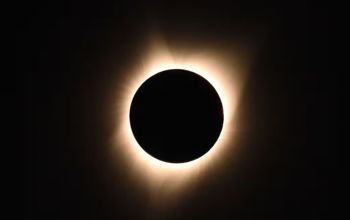
Solar Eclipse
Wednesday 12th August 2026
The do's and don'ts of viewing the upcoming solar eclipse
RTE News 'How to avoid permanent eye damage when viewing the solar eclipse' Dr Mark Cahill, Retina Specialist, Royal Victoria Eye and Ear Hospital
The most prominent solar eclipse in 27 years is expected to be visible from Ireland on Wednesday 12th August 2026.
People all over the country will get to experience the partial solar eclipse just after 6pm as the moon moves in front of the sun, with maximum coverage of the sun occurring shortly after 7pm. The significant partial eclipse, which will see between 94 per cent and 97 per cent of the sun covered on Wednesday, is the first of its kind to be visible in Ireland since August 1999 when 95 per cent was covered.
Areas in the south west of Ireland will see the greatest percentage coverage for the eclipse, with Cork set to see almost 98%. The percentage coverage will decrease as you travel north east, with Dublin having 94% and Belfast set for 93%. For anyone hoping to get a view of the total solar eclipse, the best route from Ireland will be to head to northern Spain.
Eye safety guidance for viewing a solar eclipse
A solar eclipse is a rare and special occasion for people to enjoy but it is also potentially very harmful to your eyes if viewed directly.
Mr Gerry Fahy, Consultant Ophthalmologist and President of the Irish College of Ophthalmologists (ICO), has the following guidance:
"It is important for people to be aware of the permanent damage that can be caused by looking directly at the sun with the naked eye, and most especially during an eclipse. Staring directly at the sun can permanently scar the retina, and cause irreversible loss of central vision.
After a solar eclipse episode, ophthalmologists see patients who present with solar burns to the retina and or macula which is termed solar retinopathy or solar maculopathy. Solar burns to the retina are not painful. The loss of vision is not always immediate but if damage is done, it is unfortunately frequently irreversible. Eye doctors would like to remind people to take the necessary safety measures which are simple, to protect the eye from solar damage.
The ICO advises exercising extreme caution where children are concerned. Children should not be allowed to look directly at the sun at any time. The potential damage is usually more severe because the child's natural lens is so clear that it lets more ultraviolet (UV) rays reach the back of the eye.
The College has the following guidance for individuals and families who are looking forward to viewing the eclipse on Wednesday:
Don’t:
- Don’t look directly at the sun with the naked eye or even with sunglasses on – they don’t offer sufficient protection.
- Don’t watch it directly through a telescope, binoculars, camera or camera-phone. Even if you are just lining up the projection, this still puts you at risk.
- Don’t attempt a ‘Selfie’ on your camera-phone - glancing at the sun, even brief exposure can lead to damage of the retina
- Don’t view through smoked glass, stacked sunglasses, polarised shades or photographic filters.
Do enjoy the eclipse by:
- Using certified eclipse glasses which have filters made with special material to reject the sun’s dangerous energy across various wavelengths, but check for any pinholes first by holding them up to a light, and discard if you notice any scratches. Visit https://astronomy.ie/
- Looking at sun indirectly using the old-fashioned, home-made pinhole projection method. This involves putting a hole in a piece of cardboard, and holding the cardboard up – with your back to the sun – so that an image of the sun is projected onto another piece of paper or card. This works well using a cardboard box, and will allow you to see the progress of the eclipse without damaging your eyes
- Going to one of the many viewing events being run by astronomy clubs and other organisations around the country to watch the eclipse where experienced astronomers will be on hand with specially adapted telescopes through which it will be possible to view the eclipse safely.
- Viewing livestreams available online through which you can watch the event. The European Space Agency (ESA) will be hosting a live broadcast, meaning astronomy enthusiasts won't need to rely on favourable weather conditions to witness the spectacle as it occurs.
For further information on practical and safe ways to watch the show unfold are described in a booklet at eclipse26.ie, compiled by Dunsink Observatory and ESERO Ireland. Visit Astronomy Ireland for all the latest news and updates on the 12th August eclipse https://astronomy.ie/
Irish Times 'Doctors warn over increased risk of permanent eye damage during solar eclipse' Dr Gerry Fahy, President, ICO and Mr Mark Cahill
ENDS
10th August 2026